Compared to What? a field guide
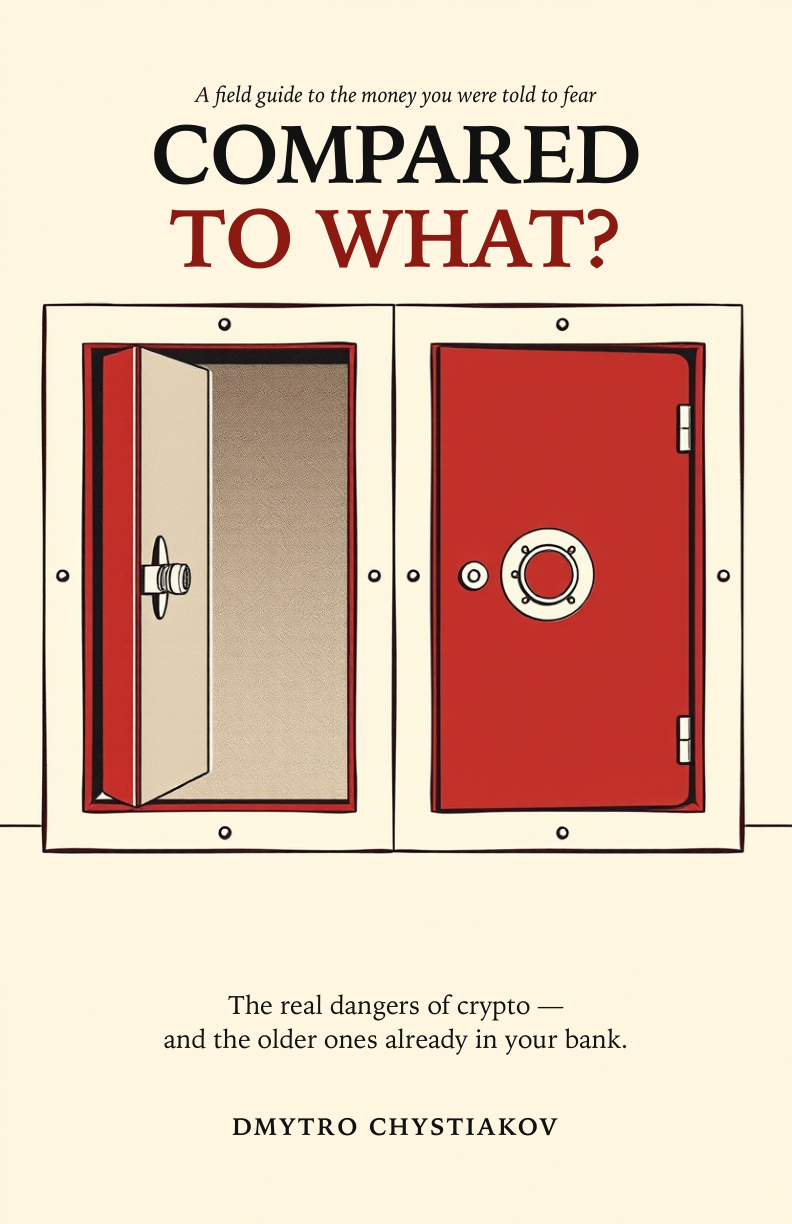
A field guide to the money you were told to fear

COMPAREDTO WHAT?

The real dangers of crypto — and the older ones already in your bank.

Dmytro Chystiakov

A research-driven book about recurring financial patterns — built on years of documented incidents and publicly verifiable evidence.
COMPARED TO WHAT?
Hover to watch · Chapter 1
Get the first case — free On sale soon — Amazon · Apple Books · Google Play

In August 2024, a man in Washington lost $243 million to a phone call. No code was broken. No wallet failed. Everything worked exactly as designed — and that is the problem this book takes seriously.

What it is
650+
documented incidents, 2010–2026

The book takes crypto’s real dangers one at a time and sets each beside its twin already running in ordinary finance.

Each chapter ends with an honest verdict about which is worse — and the verdicts do not all go one way. Crypto did not invent these crimes. The technology changed; the financial mechanisms didn’t.

Crypto did not invent these crimes. It wrote them down.

From the book

The evidence, drawn

No stock art, no AI. Every figure redraws itself from a committed data file — the same numbers anyone can check. Three plates from the book.

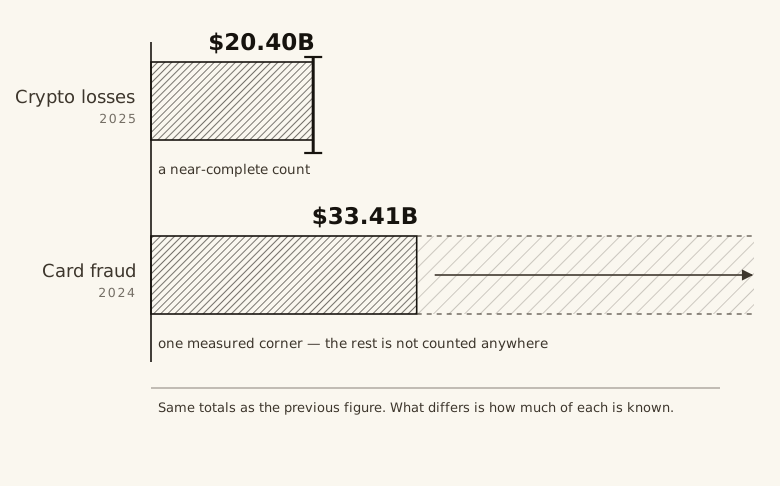
Two error bars: crypto's loss estimate is narrow and capped, while the traditional-fraud estimate is an open floor with an arrow leaving the top of the frame.
PlateCeiling and floor. Crypto's $20.40B is a near-complete count. Card fraud's $33.41B is one measured corner — the rest is counted nowhere.
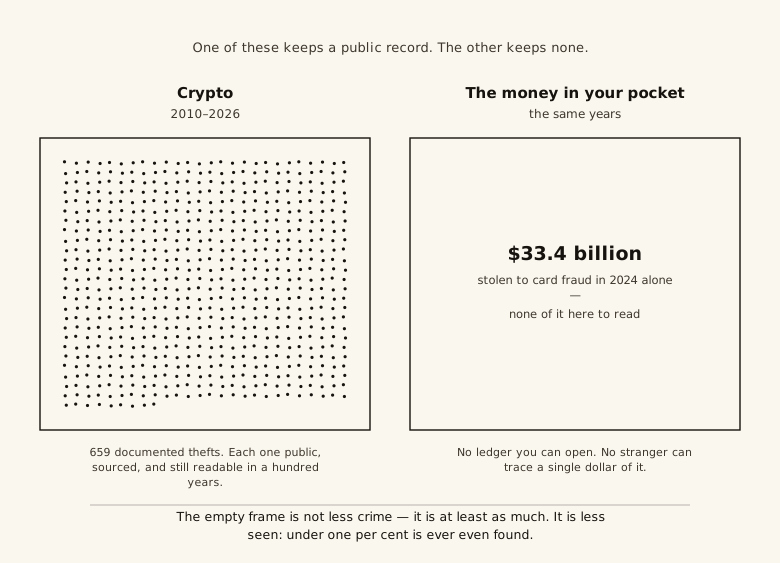
Two frames of the same years side by side: the left is filled with 659 marks, one per documented crypto theft; the right, for the traditional financial system, is empty of any public record.
PlateThe empty frame. On the left, 659 documented crypto thefts. On the right, the same years in ordinary finance — no public record to fill it.
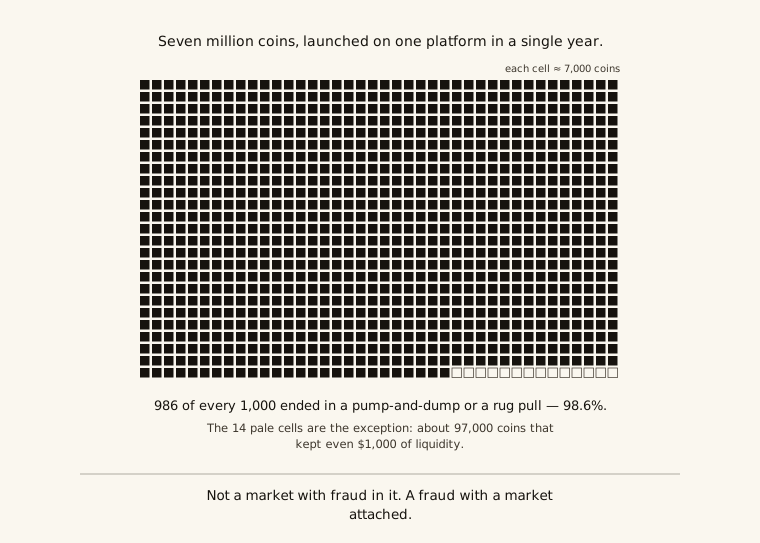
A grid of 1,000 cells, each standing for about 7,000 tokens; 986 are filled solid and 14 left blank — 98.6 percent of the tokens ended in a pump-and-dump or a rug pull.
PlateA fraud with a market. One market, a thousand cells. 98.6% of its tokens ended in a pump-and-dump or a rug pull.
The evidence

Every number is checkable

Every incident in this book exists in the public record — court filings, regulator reports, on-chain transactions anyone can read. See it: the verification index — claim by claim, artifact by artifact.

The catalogue
OnChainAttack (OAK)

650+ documented incidents, every one classified with a citation for every claim. Free and public on GitHub.

onchainattack.org →
The proof
Verification index

Claim by claim, artifact by artifact. Follow any number in the book back to the public record that checks it.

The verification index →
The takeaway
The Six

Six rules that stop most of the thefts in the book. A free poster — print it, share it.

Download the poster (PDF) →
Check it yourself

Six and four

Your wallet identifies an address by its ends — the first characters and the last. Here are two, exactly as it would show them to you.

A transfer you just made0x7A3F…4E210x7A3F9d2E5b1c8f0A6D4b3E7c9A1f0B2c5D8e4E21
Another, from the same history0x7A3F…4E210x7A3F0c1B7a4D9e2F8c3A5b6E1d0F4a9C2b7E4E21

Same address, or different?

The ends are identical — 0x7A3F … 4E21 — and that is all your wallet ever showed you. The middles are completely different. An attacker slips a lookalike into your history so you copy the wrong one and send your money to them. It is the shortest chapter in the book, because the whole mechanism is one sentence.

Two stories from the book
Chapter 1 — The phone call
Chapter 8 — 98.6%
Before it’s published

Get The First Case, free

Subscribe and I'll send you The First Case: the opening of the book and its first chapter in full — the phone call that cost one man $243 million. After that, one email when the book is released. Nothing else.

Confirmation by email, unsubscribe in one click. The address is used for this list and nothing else — no tracking, no sharing.

About the author

Dmytro Chystiakov is the author of OAK, a public catalogue of 650+ documented crypto incidents. He has worked in banking, cybersecurity and AI — and wrote the book he needed when he was first deciding whether to step into crypto. Why I spent years documenting crypto incidents →

The free incident catalogue (OAK) on GitHub →